Originally published via WRI Polsky Center for the Global Energy Transition
Flexibility as infrastructure
Electricity demand is now growing faster than grids can be expanded.
The industry’s default response is still predictable: build more wires, build more capacity, and manage ever-longer connection queues. Network investment remains essential, but it is increasingly clear that this approach alone will be too slow and too expensive to keep pace with electrification.
The fastest, cheapest source of additional grid capacity is the latent capacity sitting behind distributed energy resources (DERs) that are already connected to our networks.
We often hear that flexibility is “not a technology problem, but a paper problem.”
I think that’s true – but especially so for grid flexibility. We already know how to dispatch DERs. We already have mature software platforms and control systems that have aggregated GWs of DERs. What’s missing is market design.
Utilities need clearer reasons (incentives) to buy grid flexibility. DER owners need more opportunities to monetise the flexibility they can already provide. Investors need additional revenue streams that make new flexible assets bankable.
The opportunity is to create a larger, more liquid flexibility market that benefits everyone: more value for utilities, more investable revenue streams for financiers, and more monetisation opportunities for flexible assets. That is what makes the distinction between energy flexibility and grid flexibility so important.
Energy flexibility versus grid flexibility
The industry has already demonstrated that energy flexibility can scale.
Today there are gigawatts of flexible capacity participating in markets across the UK, California, and many other jurisdictions through:
- Capacity markets
- Resource adequacy programmes
- Demand flexibility services
- Wholesale and balancing markets
- Various Virtual Power Plant (VPP) programmes
These mechanisms use flexible resources to balance energy supply and demand across the electricity system.
But we are still only scratching the surface of grid flexibility.
Grid flexibility uses many of the same DERs, but for a different purpose: increasing the capacity of existing networks, reducing congestion and connecting customers faster.
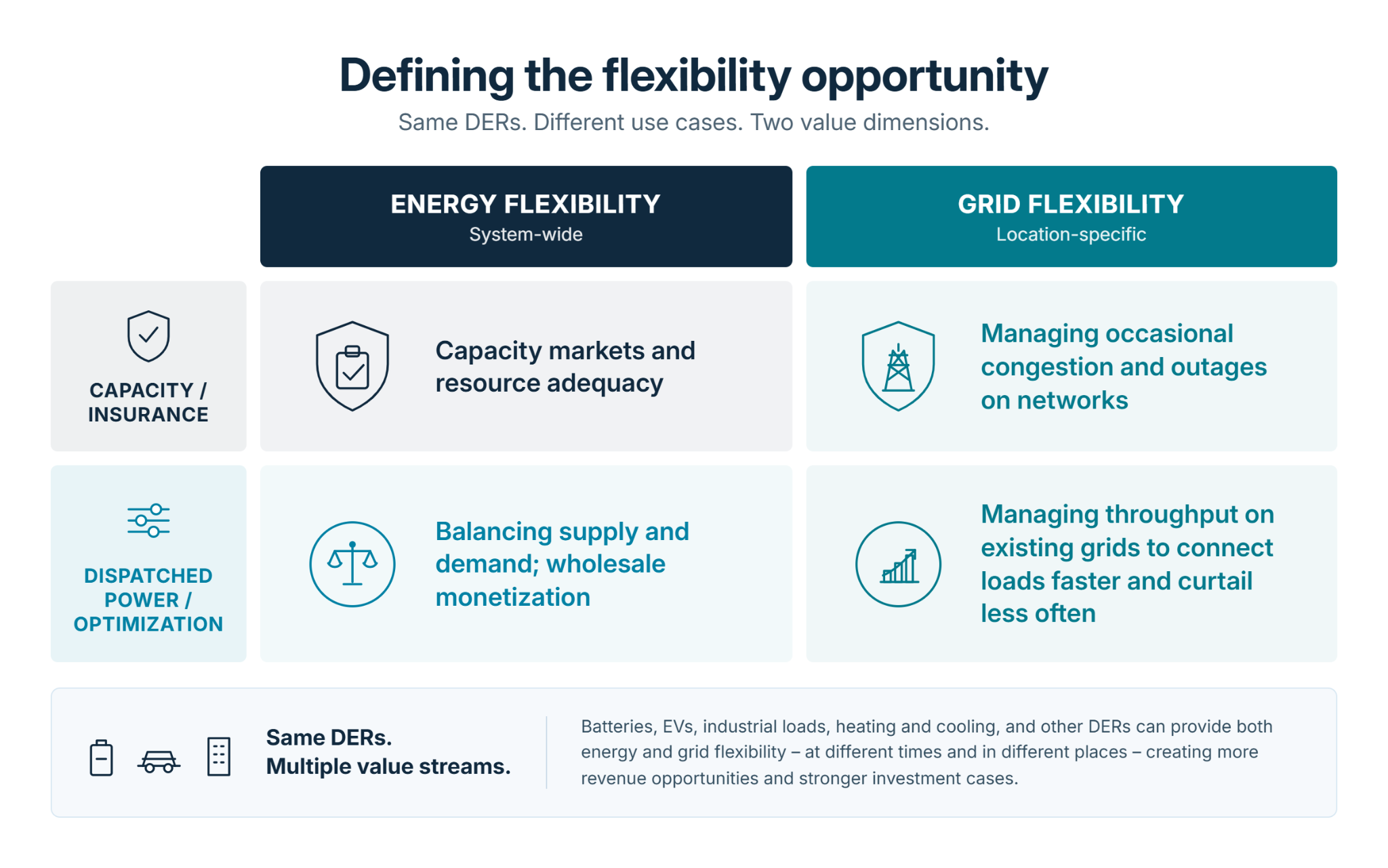
One important point is that this distinction largely doesn’t matter to the owner of the flexible asset.
A battery, EV fleet, heat pump, or industrial load does not fundamentally care whether it is being dispatched to balance the wholesale electricity system or to relieve a local network constraint. The same DER can often provide both services at different times.
What matters to asset owners is having more opportunities to earn revenue.
The goal is therefore not to separate energy flexibility and grid flexibility into competing markets. It is to build a mature grid flexibility market alongside existing energy markets, creating more price signals, more routes to market, and ultimately stronger investment cases for flexible assets.
In other words, scaling grid flexibility doesn’t fragment liquidity – it expands it.
The more valuable flexibility becomes across multiple use cases, the more DERs will be deployed, improving liquidity and competition across both energy and grid flexibility markets.
Grid flexibility then creates value in two distinct ways.
1. Managing grid risk
The first role is using flexibility as an operational alternative to physical redundancy – which is the backup capacity utilities traditionally build (extra lines, transformers, generation headroom) to cover outages or peak demand. This includes:
- Managing occasional congestion and network outages
- Deferring or avoiding reinforcement
- Supporting outage management and resilience
- Coordinating construction programmes
- Active network management
Utilities have decades of experience valuing physical redundancy. We are still learning how to value flexible redundancy.
As a result, grid flexibility is too often funded through utilities’ innovation budgets or discretionary operating expenditure (one-off, exploratory pots of money) rather than being treated as a core operational risk management capability, funded the way physical infrastructure is.
2. Increasing grid throughput
The second opportunity is even larger.
Instead of viewing flexibility as emergency support, we should increasingly view it as a way to increase the throughput of existing networks.
That includes:
- Flexible connection agreements
- Dynamic operating limits
- Managed access arrangements
- Dispatch during constrained periods
- Batteries supporting local network capacity
- Coordinated DER orchestration
Every constrained connection represents latent utilisation sitting within today’s network.
Personally, I think almost every new large connection should initially be flexible or “non-firm”. That means connecting on the condition that the network operator can temporarily reduce or pause supply during rare periods when the local network is under strain, rather than waiting years for reinforcement to finish.
Accepting that trade-off can cut connection times dramatically, creating greater economies of value. In some examples for large loads, flexible connection times can drop from five to eight years down to a year or two, while reinforcement continues in parallel behind the scenes, so the flexible connection can become unrestricted or “firm” once the network catches up.
Done well, flexibility becomes infrastructure.
This is the grid-side complement to a broader electrification challenge. As Clem Perry argued in the WRI Polsky Energy Center’s recent explainer, the goal is not simply to electrify more, but to electrify better – ensuring that new electric demand connects in ways that strengthen, rather than overwhelm, the power system.
Batteries, controllable demand, dynamic operating limits, and DERs all become tools for accelerating economic growth rather than simply managing constraints.
What needs to change?
The technology therefore largely exists and the barriers that remain are institutional.
1. Focus on rewarding outcomes
Today’s regulatory frameworks still predominantly reward capital deployment. Flexibility frequently sits within innovation funding or discretionary operating budgets, as mentioned above.
That is increasingly the wrong model. Rather than creating ever more flexibility-specific mechanisms, regulators should focus on rewarding outcomes:
- Faster customer connections
- Lower congestion risk
- Higher asset utilisation
- Lower consumer costs
- Greater system resilience
The role of policy should not be to choose technologies but rather to reward outcomes.
Utilities can then deploy the combination that delivers those outcomes most efficiently: flexibility, storage, grid-enhancing technologies, active network management, dynamic connections, reconductoring, digital orchestration, or conventional reinforcement.
2. Create financing models for flexible infrastructure
The second challenge is financial rather than technical.
Today:
- Financiers struggle to price curtailment risk.
- Utilities struggle to value optionality.
- Battery developers cannot fully monetise local grid value.
- Large customers need confidence in firm access.
- Flexible assets need predictable long-term revenues.
We need financing structures that make grid flexibility bankable – creating investable revenue streams that sit alongside existing energy market revenues rather than replacing them.
That means unlocking an additional value stack from the same assets, benefiting networks, investors, and consumers alike.
Examples include:
- Local flexibility-backed batteries
- Shared capacity infrastructure
- Flexible connection agreements
- Congestion management contracts
- Flexibility insurance and hedging products
There is enormous infrastructure value sitting behind constrained networks.
Yet we still tend to treat flexibility as temporary operational behaviour rather than durable infrastructure capable of attracting institutional capital.
The opportunity
This is what gives me optimism:
- We already have the DERs.
- We already have the control and dispatch software.
- We have already proved that flexibility works.
Now we need the regulatory incentives, commercial models, and financing structures that allow grid flexibility to become a core part of how we expand electricity networks.
Grid expansion and grid flexibility are not competing but are complementary.
The faster we treat flexibility as infrastructure rather than an exception, the faster we can connect new generation, new demand and unlock new economic growth.
I’d be interested to hear how others across utilities, regulators, developers, investors and technology providers are thinking about this. Where do you see the biggest barriers – and the biggest opportunities – for making grid flexibility a core part of the electricity system?
If you have any thoughts, get in touch.